
Introduction
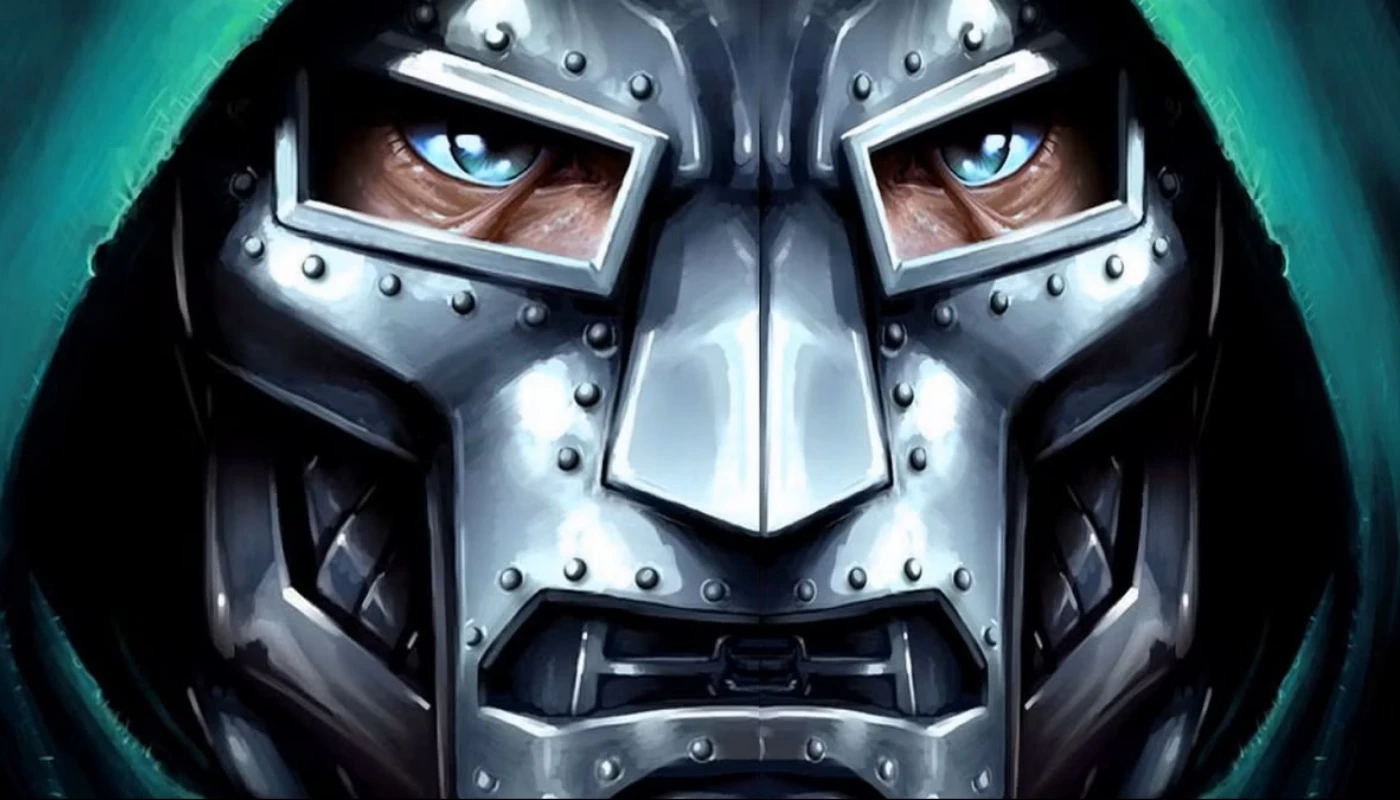
In the vast and infinite expanse of the Marvel Universe, countless villains have threatened cities, conquered planets, and laid waste to entire galaxies. Yet, none command the absolute reverence, terrifying majesty, and sheer narrative weight of Victor von Doom. Clad in a forged titanium battle suit and draped in his iconic emerald cloak, the sovereign monarch of Latveria represents the absolute pinnacle of villainous sophistication. He is not merely a mad scientist plotting in the shadows, nor is he simply a dark sorcerer uttering ancient curses from a forgotten tome. Doctor Doom stands as a terrifying fusion of both worlds, bridging cutting-edge scientific innovation with profound mastery over the occult.
His presence dominates every panel he inhabits, projecting an aura of divine right and ironclad authority. Unlike common criminals or cosmic destroyers driven by mindless fury, Doom acts with absolute purpose. Every scheme, every grand declaration, and every clash with Earth’s mightiest heroes stems from a core belief that humanity’s ultimate salvation lies exclusively under his benevolent, iron-fisted rule. He looks upon the pantheons of gods, cosmic entities, and costumed vigilantes not with fear, but with a cold, calculating certainty that he is their superior in every conceivable metric. This unshakeable conviction elevates him far above the realm of standard comic book antagonists.
To understand Victor von Doom is to appreciate a character built on grand tragic contradictions. He is a ruthless dictator who wields total state control over his homeland, yet his citizens genuine love and revere him for protecting them from the chaos of the outside world. He is a man driven by an ego so monumental that he refuses to bow to cosmic pantheons, yet he is bound by a strict, unbreakable personal code of honor that forces him to keep his word once given. He has saved reality just as many times as he has tried to conquer it, proving time and again that his genius is the ultimate wild card in the cosmic balance.
The sheer versatility of Doctor Doom has allowed him to transcend his original role as the archenemy of the Fantastic Four. Over the decades, his ambitions have brought him into conflict with Spider-Man, Iron Man, Doctor Strange, Black Panther, the X-Men, and the Avengers. He has stood toe-to-toe with Galactus, stolen the power of the Silver Surfer, tricked demonic lords, and seized the omnipotent power of the Beyonders to reshape the entire multiverse in his image. His influence ripples across every corner of Marvel Comics, making him a fundamental pillar of modern myth-making.
Beyond his comic page exploits, Doctor Doom represents an indelible cultural icon whose design and archetype have shaped decades of popular media. From his striking, ominous silhouette to his booming, third-person theatrical speech, Victor von Doom set the standard for what a master supervillain should be. He is a character who demands total respect, forcing both the heroes within his universe and the audience reading his stories to acknowledge his towering presence.
As Marvel Studios prepares to bring Victor von Doom to the absolute forefront of the Marvel Cinematic Universe in Avengers: Doomsday, interest in the Master of Latveria has reached an all-time high. This definitive character summary serves as your ultimate pillar guide to understanding the complex history, incomprehensible powers, psychological depth, and enduring legacy of Earth-616’s most legendary mastermind.
Personality
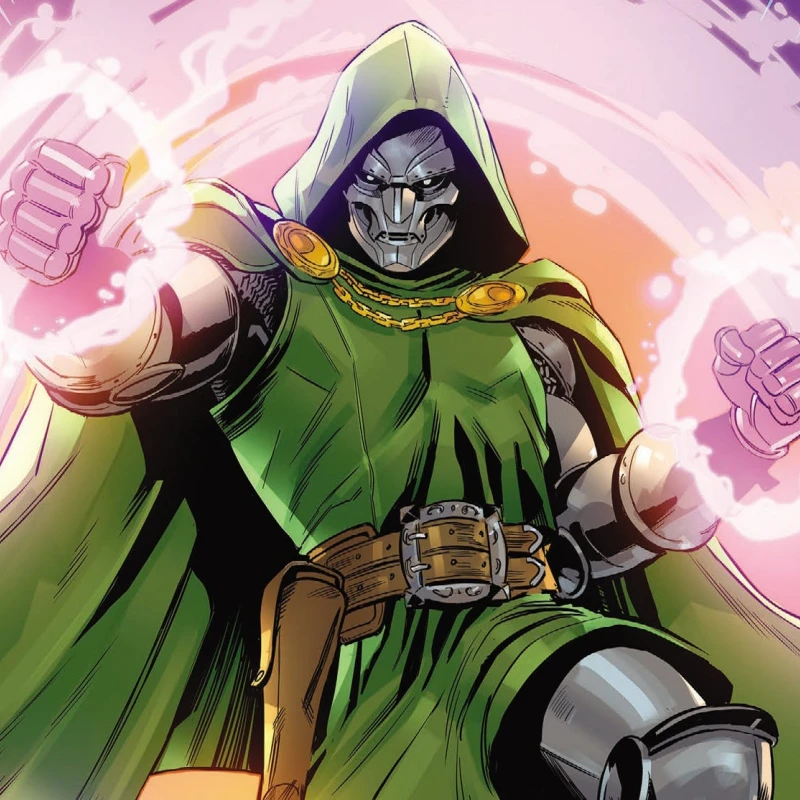
At the very core of Victor von Doom’s soul lies an intoxicating, monumental ego that borders on the divine. Victor genuinely views himself as the single most intelligent, capable, and visionary being in existence. To Doom, arrogance is not a flaw or a posture; it is a simple, objective fact of reality that others are merely too blind or weak-willed to accept. He speaks of himself almost exclusively in the grand third person, projecting a regal detachment that signals to everyone around him that they are speaking with royalty. This supreme self-worth dictates every aspect of his behavior, making him virtually immune to intimidation, brainwashing, or psychological manipulation.
Yet, beneath this staggering facade of absolute vanity lies a deeply complex moral framework governed by a rigid code of personal honor. Doctor Doom does not engage in petty cruelty or senseless, chaotic violence. If he gives his royal word or signs a binding pact, he will honor it down to the exact letter, regardless of how inconvenient it may become. He holds a profound, aristocratic respect for adversaries who exhibit true strength, intellect, or noble sacrifice, often sparing or praising enemies who earn his admiration. This chivalric trait transforms him from a standard tyrannical megalomaniac into an honorable, albeit terrifying, anti-hero.
Doom’s relationship with power is uniquely paternalistic rather than purely tyrannical. When he governs his homeland of Latveria, he does so with absolute authority, eliminating crime, poverty, and disease through his advanced technology. He views his subjects not as disposable peasants, but as his personal charges whom he is duty-bound to protect from internal suffering and external invasion. In return, he demands complete obedience and unconditional loyalty. When Victor seeks to conquer the globe, he does so out of a genuine, unshakeable belief that democratic governments are flawed and that only his absolute control can usher in an era of total galactic peace and prosperity.
Despite his royal demeanor and vast intellect, Victor von Doom is haunted by profound psychological scars and tragic emotional burdens. The loss of his mother, Cynthia von Doom, to the dark forces of the demon Mephisto implanted an enduring obsession with rescuing her soul from damnation. Every year on his birthday, Doom risks his life in a magical duel against Mephisto to win his mother’s freedom, demonstrating a fierce, tragic loyalty to his Romani bloodline. This emotional vulnerability reveals that behind the cold titanium faceplate beats the heart of a grieving son willing to storm the gates of Hell itself.
The darker, more dangerous side of Doom’s personality is defined by his obsessive, consuming envy of Reed Richards, Mr. Fantastic. Victor cannot tolerate the existence of anyone whose intellect might equal or exceed his own. He blames Richards for the collegiate lab accident that scarred his face, refusing to admit that his own flawed calculations caused the explosion. This petty feud has driven Victor to commit heinous acts, sabotage his own triumphs, and risk world safety simply to force Reed Richards to acknowledge his total superiority. It is the ultimate tragic paradox of his character: a man capable of touching godhood, anchored down by a petty mortal grudge.
Ultimately, Victor von Doom possesses an indomitable strength of will that is virtually unmatched in the entire Marvel Universe. His mental fortitude is so immense that he can resist mind control, endure unfathomable physical torture, and look reality-warping entities in the eye without flinching. When cast into the prehistoric past or trapped in the depths of Hell, Victor does not despair; he simply survives, adapts, and spends centuries plotting his triumphant return. It is this absolute, unyielding discipline that makes his personality one of the most formidable forces in comics history.
Attributes & Abilities
| Height | 6′2″ (Normally) 6′7″ (In Armour) |
| Eyes | Brown |
| Weight | 102.06 kg (Normally) 188.24 kg (In Armour) |
| Hair | Brown |
| Gender | Male |
| Universe | Marvel Universe (Earth-616) |
| Other Aliases | Master of Latveria God Emperor Doom The Infamous Iron Man The Creator Invincible Man Master of Science and Sorcery |
| Education | College studies in science at Empire State University (expelled) Self-educated to doctorate level in sciences Self-taught master of the mystic arts |
| Place of Origin | Haasenstadt (later Doomstadt), Latveria |
| Identity | No Dual |
| Known Relatives | Cynthia von Doom (mother, deceased) Werner von Doom (father, deceased) Boris Karela (guardian/adoptive father) Kristoff Vernard (adopted son) Caroline Le Fay (daughter) Valeria Richards (goddaughter) |
| Powers | Super-genius intellect Advanced sorcery & spellcasting Mind transference (Ovoid technique) Energy & plasma projection (via suit & magic) Personal force-field generation Hypersonic flight Dimensional & time travel Technopathy & cybernetic manipulation Superhuman strength & durability (via titanium battle armour) |
| Group Affiliation | Supreme Monarch of Latveria Parliament of Doom Acts of Vengeance Prime Movers Intelligencia The Cabal Fantastic Four (formerly) Future Foundation (formerly) |
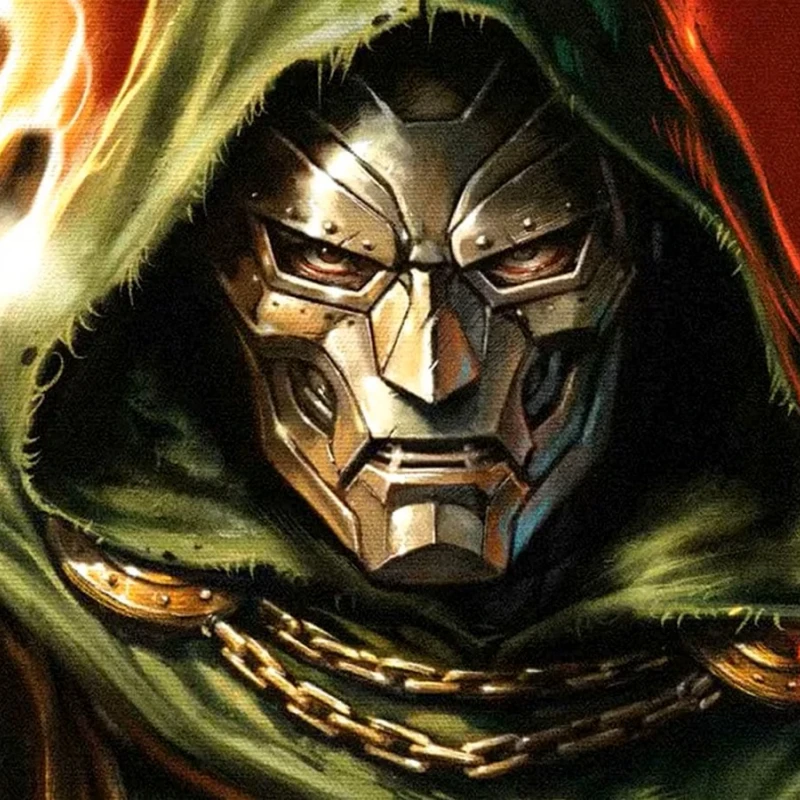
The physical and intellectual attributes of Victor von Doom place him in the absolute upper echelon of Earth-616 mortals. Standing six feet two inches tall in his natural form and swelling to six feet seven inches when clad in his massive nuclear-powered battle armor, he possesses a imposing physical presence. Weighing one hundred and two kilograms unarmored and over one hundred and eighty kilograms when encased in high-strength titanium alloy, his sheer physical stature commands immediate respect on the battlefield. His brown eyes cut through adversaries with piercing intensity, while his scarred features remain hidden behind his terrifying iron mask.
At the heart of Doom’s power is his super-genius intellect, an omnicompetent mind capable of mastering virtually every field of human endeavor. He is a world-class authority in theoretical physics, robotics, cybernetics, weapons technology, biochemistry, temporal mechanics, and genetics. Victor engineered a fully functioning time platform independently, pioneered advanced artificial intelligence to construct autonomous Doombots, and has even successfully performed delicate neurosurgery when required. His scientific prowess is so vast that he routinely constructs technological counter-measures that neutralize cosmic entities, siphon energy from divine beings, and rival the greatest breakthroughs of Stark Industries.
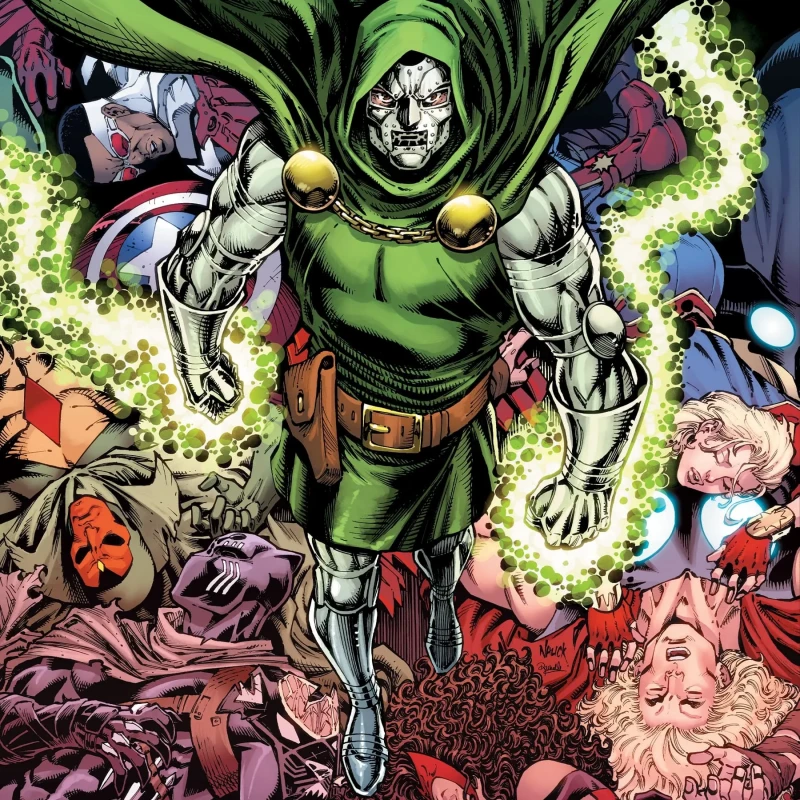
What makes Doctor Doom exponentially more dangerous than traditional scientific geniuses is his terrifying mastery over the mystic arts. Inheriting latent magical potential from his Romani mother, Victor expanded his occult knowledge by studying under secret orders of Tibetan monks, traveling through time to learn forgotten dark arts from Morgan le Fay, and deciphering ancient grimoires. His spellcasting abilities are so advanced that he was considered a primary candidate for the title of Sorcerer Supreme when Doctor Strange stepped down. Doom can unleash mystical blasts, generate force-fields, summon armies of demonic entities, manipulate elemental blizzards, teleport across dimensions, and cast power-nullifying wards.
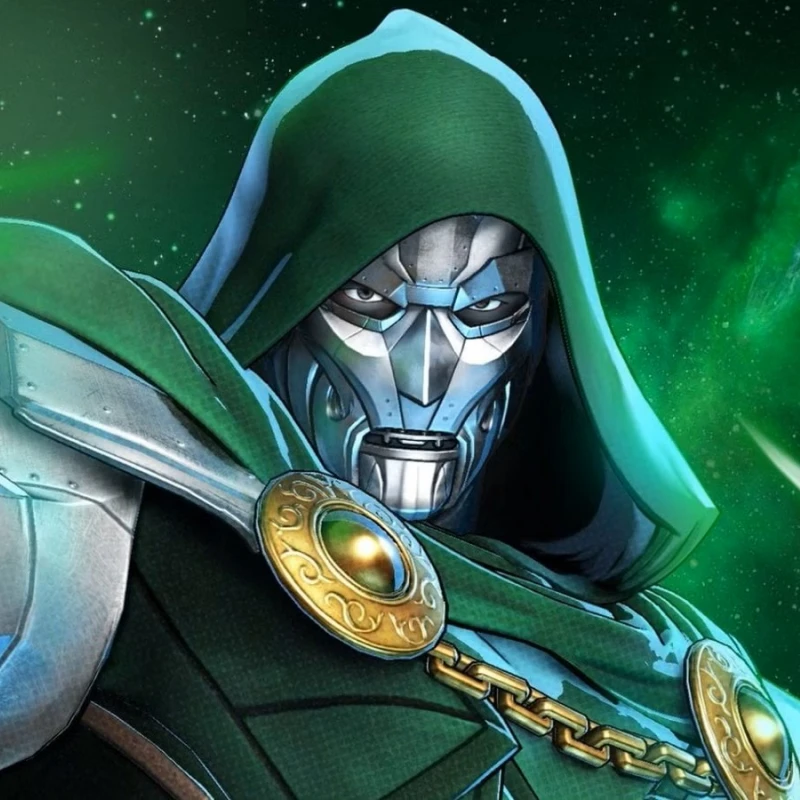
The primary instrument through which Doom channels his physical power is his legendary nuclear-powered, computer-assisted battle armor. Magically forged in a hidden Tibetan monastery and refined through continuous technological upgrades, the high-strength titanium suit grants him superhuman strength capable of pressing dozens of tons and going toe-to-toe with powerhouse heroes like Spider-Man and the Thing. The armor is equipped with miniaturized propulsion systems for hypersonic flight, wrist-mounted video communicators, and an outer shell capable of discharging a massive electric shock to anyone foolish enough to make physical contact.
Beyond basic defense, Victor’s armor houses an arsenal of offensive weaponry and protective barriers. High-concussive plasma beams, laser systems, and thermal rays can be discharged directly from the gauntlets or faceplate. His personal force-field generator creates near-impenetrable barriers capable of tanking point-blank nuclear detonations, heavy artillery, and blasts from cosmic beings. Furthermore, the suit contains fully self-sustaining life-support systems, allowing Doom to survive indefinitely in the vacuum of space, deep underwater, or inside toxic alien environments without taking harm.
In addition to his technological and magical gifts, Victor von Doom possesses exotic alien techniques and diplomatic protections that make him nearly impossible to defeat permanently. Through training with the alien Ovoid race, Doom mastered mind transference, allowing him to swap his consciousness into any nearby human being simply by making eye contact—a power he utilizes as an ultimate fail-safe when his body is destroyed. As the absolute monarch of Latveria, he also enjoys full diplomatic immunity on foreign soil, meaning Earth’s authorities and costumed heroes are legally barred from arresting him when he visits the United Nations or his country’s embassy.
Weaknesses
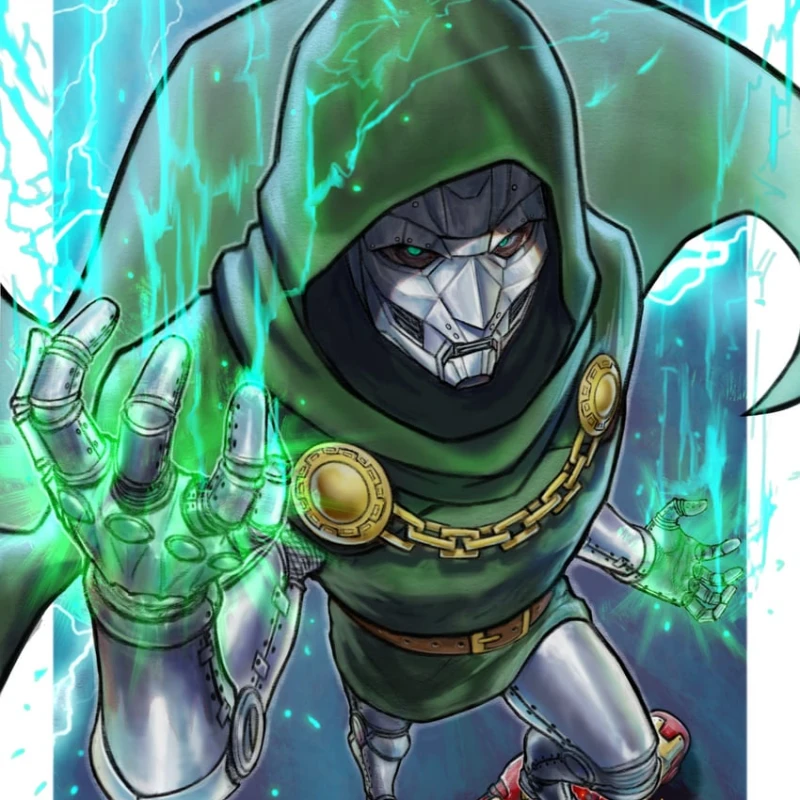
While Doctor Doom boasts an arsenal that can challenge gods, his single greatest vulnerability is his own overwhelming hubris. Doom’s absolute belief in his intellectual invincibility causes him to suffer from severe blind spots during tactical planning. He routinely underestimates his opponents, dismissing them as inferior insects who are incapable of outsmarting his grand schemes. This towering pride often leads him to overlook simple human variables, minor technological glitches, or unexpected sacrifices made by heroes, resulting in his grand plans collapsing at the very brink of absolute victory.
Closely linked to his ego is his unhinged, irrational emotional fixation on Reed Richards. Time and again, Victor has attained supreme, reality-altering power that could allow him to reshape the universe into a perfect utopia. However, his pathological need to force Reed Richards to bow before him and admit defeat consistently derails his triumphs. Opponents who understand Doom’s psychology can easily manipulate him by pandering to his vanity or challenging his intellectual superiority, goading him into rash actions or forcing him to abandon strategic advantages purely to defend his royal pride.
Another profound weakness stems from the psychological trauma associated with his facial disfigurement. When Victor was a young man at Empire State University, his face was lightly scarred during the explosion of his dimensional viewing machine. His obsession with his own aesthetic perfection was so extreme that he considered his countenance utterly ruined. In his haste to hide his flaw, he placed his freshly forged iron mask onto his face while the metal was still smoking from the forge, causing horrific, permanent burns. This deep-seated vanity leaves him sensitive to insults regarding his appearance, driving him into unbridled rages.
From a magical standpoint, Doom’s reliance on dark pacts and forbidden arts has occasionally backfired with catastrophic results. While his sorcery rivals that of elite practitioners, his willingness to bargain with malevolent entities like the Haazareth Three exposes him to severe supernatural retribution. On occasions where he has angered these demonic pact-makers, they have stripped away his mystical abilities, turned his own sorcery against him, or dragged his soul into the depths of Hell for eternal torment. His magical power is immensely potent, but it carries a terrifying cost that occasionally brings about his downfall.
Technologically, while his armor and Doombots represent marvels of engineering, they are still susceptible to specialized disruption. Advanced technopaths, high-level EMP weapons, and reality-warping energy discharges can temporarily compromise his suit’s electronic grid, force-fields, and sensory feedback. Furthermore, his heavy reliance on robotic Doombot doubles to manage his empire and battle his enemies sometimes creates exploitable glitches. On rare occasions, advanced Doombots programmed with his memories have become so convinced that they are the real Victor von Doom that they have turned against their creator, initiating civil conflicts within Latveria.
Finally, despite his vast array of enhancements, magical shields, and battle suits, Victor von Doom is fundamentally a mortal human being beneath his titanium shell. Without his armor’s protective force-fields or active magical wards, his physical body is susceptible to conventional physical trauma, disease, exhaustion, and mortal injury. If an opponent manages to bypass his outer technological and occult defenses, Victor can be harmed or incapacitated just like any other man, forcing him to rely entirely on his Ovoid mind-swapping techniques or medical science to survive.
Power Grid
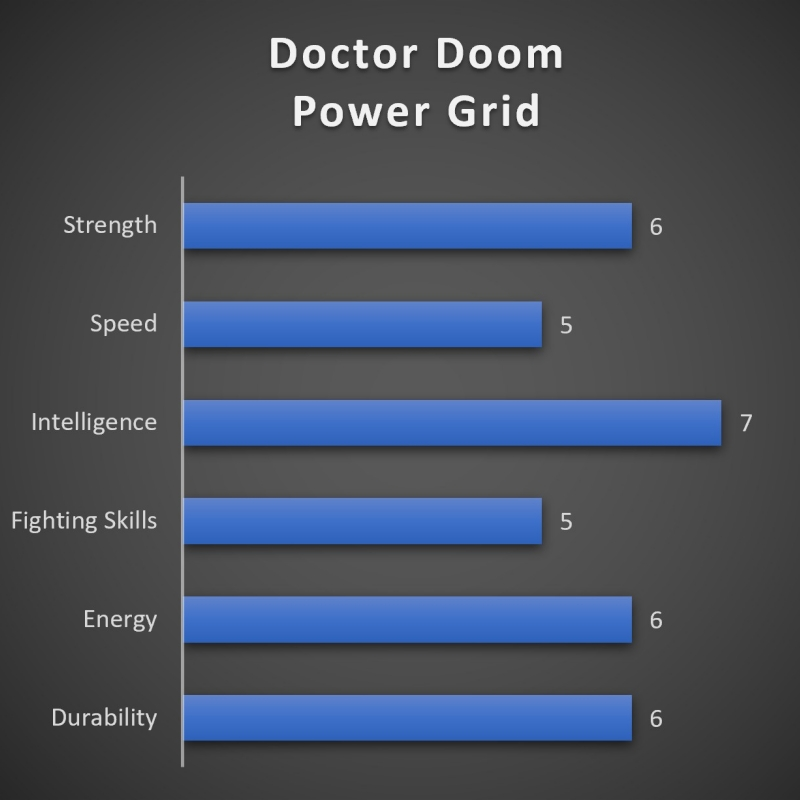
In terms of raw Intelligence, Doctor Doom achieves the absolute maximum rating of 7 out of 7 on the official Marvel scale. He is an omnicompetent super-genius whose mental capacity encompasses every known discipline of science, engineering, and magic. His ability to comprehend complex cosmic systems, solve equations that stump entire universities, and master alien technology places him alongside Reed Richards and Moon Girl as one of the smartest mortal minds to ever exist on Earth-616.
Regarding Strength, Doctor Doom rates at a formidable 6 out of 7 when utilizing the full power of his titanium battle armor. While his natural unarmored human frame possesses standard physical conditioning, his nuclear-powered suit amplifies his muscular output to superhuman levels. He is capable of lifting and pressing upwards of one hundred tons, allowing him to overpower heavy hitters, shatter stone structures with bare gauntlets, and physically trade blows with cosmic powerhouses.
His Speed is rated at a 5 out of 7, largely powered by his suit’s miniaturized propulsion and flight thrusters. In ground combat, his reaction times are heightened by his suit’s onboard tactical computers and his extensive training in hand-to-hand martial arts. In the air, his armor allows him to achieve supersonic and hypersonic flight speeds, enabling him to cross continents in minutes, evade tracking missiles, and maneuver effortlessly during mid-air dogfights against airborne heroes.
For Durability, Doctor Doom earns a massive 6 out of 7 rating. The combination of his high-strength titanium-alloy suit, internal life-support systems, and personal force-field generator renders him invulnerable to conventional military bombardment, small arms fire, extreme temperature shifts, and biological weapons. When reinforced by his active mystical shields, Victor can withstand direct force blasts from celestial entities, heavy blows from Mjolnir, and point-blank kinetic impacts without suffering structural suit failure.
His Energy Projection stands at a devastating 6 out of 7. Victor can discharge destructive blasts through a wide variety of mediums. His technological gauntlets can fire concussive force bolts, laser beams, and high-voltage electrical arcs, while his magical training allows him to unleash mystical plasma discharges, hellfire, and elemental energy. He can modulate his energy output from non-lethal stun blasts to total atomic disintegrations with absolute precision.
Finally, his Fighting Skills are rated at a solid 5 out of 7. Though Victor relies heavily on his advanced armor and spellcasting during battle, he is a seasoned hand-to-hand combatant. Trained by elite martial masters and Tibetan monks, he is highly proficient in armed combat, swordsmanship, and nerve-strike techniques. He has successfully defeated skilled combatants in unarmed duels, proving that even without his suit or magic, Victor von Doom remains a dangerous physical opponent.
Publication History
Doctor Doom made his groundbreaking debut in the pages of Fantastic Four #5 in July 1962, birthed from the iconic creative partnership of writer Stan Lee and artist Jack Kirby. Seeking a villain who could truly challenge Marvel’s flagship superhero family, Lee and Kirby envisioned a character who combined medieval aesthetics with terrifying futurism. Kirby designed Doom’s iconic look—a metallic mask symbolizing cold, unfeeling technology, wrapped in a regal cloak that evoked ancient feudal tyrants. The result was an immediate success that set a new benchmark for comic book antagonists.
Throughout the Silver Age of comics, Doctor Doom quickly established himself as the premier villain of the expanding Marvel Universe. While maintaining his primary feud with the Fantastic Four, creators routinely featured him across other titles to establish threat scales. He engaged in classic crossovers with Spider-Man in Amazing Spider-Man #5, clashed with the Avengers, and fought Daredevil. In 1967’s Fantastic Four #57–60, Lee and Kirby produced one of the most celebrated storylines in comic history, where Doctor Doom tricked and stole the cosmic powers of the Silver Surfer, establishing his reputation as a thief of god-like abilities.
The 1970s and 1980s saw writers deepen Victor’s backstory and tragic motivations. Titles like Super-Villain Team-Up placed Doom in the spotlight as a complex protagonist, showcasing his diplomatic maneuvers and uneasy alliances with figures like Namor the Sub-Mariner and Magneto. During Jim Shooter’s seminal 1984 crossover event Marvel Super Heroes Secret Wars, Doctor Doom took center stage on Battleworld, successfully stealing the omnipotent power of the Beyonder. This monumental event proved that Doom’s ambitions extended far beyond petty earthbound conquest.
In the late 1980s and 1990s, legendary creators continued to add literary weight to the character. Writer Roger Stern and artist Mike Mignola produced the graphic novel Doctor Doom and Doctor Strange: Triumph and Torment (1989), a masterpiece that explored Victor’s tragic love for his mother and his noble, unbreakable spirit. Writer Ed Brubaker later penned the definitive 2005 origin miniseries Books of Doom, which meticulously cataloged Victor’s rise from a persecuted Romani youth in Latveria to the most feared monarch on the planet.
The modern era of Marvel Comics saw writer Jonathan Hickman elevate Doctor Doom to unprecedented narrative heights. Through his sprawling runs on Fantastic Four, FF, and New Avengers, Hickman positioned Doom as the ultimate savior of the cosmos. This storyline culminated in 2015’s massive Secret Wars event, where Doom gathered the dying remnants of the destroyed multiverse to forge “Battleworld,” ruling as God Emperor Doom. Following the restoration of the multiverse, writer Brian Michael Bendis explored a redeemed Victor in Infamous Iron Man (2016), where Doom attempted to honor Tony Stark’s legacy by operating as a armored hero.
Today, Doctor Doom’s publication record spans over six decades of continuous, high-impact storytelling. He remains one of the most frequently published and critically acclaimed characters in Marvel history, constantly reinvented by new generations of creators while staying true to Stan Lee and Jack Kirby’s timeless core vision.
Biography
Victor von Doom was born in a Romani camp outside Haasenstadt, Latveria, to Cynthia and Werner von Doom. His mother, Cynthia, was a powerful Romani witch who sought to protect her persecuted tribe from the tyrannical rule of the local Baron. In a desperate bid for power, Cynthia made a dark deal with the demon Mephisto, which backfired tragically and resulted in her death when Victor was still a infant.
His father, Werner, a renowned medicine man, raised young Victor while keeping his late wife’s occult instruments hidden in a chest. When Werner failed to save the Baron’s wife from a terminal illness, he fled into the freezing Latverian mountains with young Victor. Werner died of exposure protecting his son, leaving young Victor an orphan consumed by grief and a burning hatred for authority.
Discovering his mother’s hidden chest of magical relics, Victor swore to master both science and sorcery to avenge his parents and free his mother’s soul from Hell. As a teenager, he constructed brilliant technological inventions to wage a guerrilla campaign against the Baron’s forces, defending his Romani tribe. Word of his genius reached the United States, earning him a full science scholarship to Empire State University in New York. It was there that Victor met Reed Richards and Ben Grimm.
Victor’s arrogance immediately sparked an intellectual rivalry with Richards. Driven by obsession, Victor constructed an interdimensional viewing machine to contact his mother’s soul in Hell. When Reed pointed out a critical mathematical error in his calculations, Victor furiously dismissed him. The machine exploded, lightly scarring Victor’s face and resulting in his expulsion from the university.
Disgraced and obsessed, Victor traveled the globe searching for ultimate knowledge. His travels brought him to the freezing peaks of the Himalayas, where he discovered a hidden order of Tibetan monks. Mastering their secret arts, Victor became the leader of the monastery and ordered the monks to forge a suit of heavy titanium battle armor. Unable to contain his impatience, Victor demanded the iron mask be placed onto his face while it was still red-hot from the forge, permanently searing the metal to his skin and birthing Doctor Doom. Returning to Latveria, Doom led a revolution, overthrew the corrupt Baron, renamed the capital Doomstadt, and declared himself supreme monarch of the nation.
With a sovereign kingdom at his disposal, Doctor Doom launched his campaign for global dominance and his eternal war against the Fantastic Four. Over the years, he allied with Namor the Sub-Mariner, stole the cosmic powers of the Silver Surfer, and constructed massive armies of Doombots to test Earth’s defenders. He repeatedly outsmarted cosmic entities and established Latveria as an untouchable global power protected by absolute diplomatic immunity. When the Atlantean kingdom was destroyed, Doom even offered his country as a refugee camp, displaying his complex geopolitical savvy.
During the cataclysmic “Incursions” that threatened to destroy the entire Marvel Multiverse, Doctor Doom took matters into his own hands. Working alongside Doctor Strange and the Molecule Man, Doom confronted the god-like Beyonders, stole their omnipotent power, and gathered the fragments of dying realities to forge “Battleworld”. For eight years, Victor ruled this reality as God Emperor Doom, holding the cosmos together through pure force of will. When Reed Richards eventually restored the prime universe, he healed Victor’s facial scars as a final act of closure, prompting Doom to briefly seek redemption as the heroic Infamous Iron Man.
However, the destiny of Doctor Doom is forever tied to Latveria and his throne. Returning to his homeland, he reclaimed his iron mask, restored his sovereign rule, and continues to guide his nation with absolute authority. Whether defending Earth from alien invasions or plotting his next grand ascension, Doctor Doom stands ready to prove to the entire universe that there is no power greater than the will of Doom.
Reception
Since his debut in 1962, Doctor Doom has earned near-universal acclaim from comic historians, literary critics, and pop culture journalists, solidifying his status as one of the greatest fictional villains ever created. Publication outlets consistently place Victor at the absolute top of villain rankings. IGN ranked Doctor Doom as the #3 Comic Book Villain of All Time, placing him behind only Magneto and the Joker, while Wizard Magazine ranked him as the #4 Greatest Villain Ever Created. Critics frequently cite his theatrical dialogue, regal demeanor, and unique fusion of sci-fi and fantasy as the blueprint for memorable character design.
Comic book scholars often praise Doctor Doom for his incredible depth and moral complexity. Unlike standard villains whose motivations are rooted in greed or mindless destruction, Doom’s actions stem from a tragic backstory, a fierce devotion to his mother, and a genuine desire to fix a broken world. Writers and fans alike appreciate that Victor is often written as the hero of his own story—a tragic monarch who carries the weight of his entire nation on his armored shoulders. This nuanced portrayal has allowed him to sustain long-running solo titles and compelling anti-hero arcs.
His reception across broader pop culture is equally massive. The visual conceptualization of Doctor Doom created by Jack Kirby heavily influenced George Lucas when designing Darth Vader, from the metallic faceplate and heavy breathing to the flowing cape and tyrannical galactic presence. Hip-hop culture famously embraced the character through underground legend MF DOOM (Daniel Dumile), who adopted Victor’s iconic metal mask, persona, and samples in his music, embedding the Latverian monarch deep into modern music history.
Within the comic book industry itself, creators consistently cite Doctor Doom as one of their favorite characters to write. Legendary writers like Stan Lee, John Byrne, Jonathan Hickman, and Ed Brubaker have spoken fondly of Victor’s grand, booming dialogue and unstoppable presence. Lee famously noted that Doom was one of his favorite creations because his diplomatic immunity meant he could walk down a street in New York, wave to the police, and they couldn’t touch him—a concept that brought real-world political intrigue into superhero comics.
Fan reception for Doctor Doom remains exceptionally passionate across generations. Whether through classic comic runs, animated television series, video games like Marvel vs. Capcom, or feature films, fans continue to celebrate his incredible feats, iconic quotes, and unshakeable confidence. His catchphrases and grand declarations are widely quoted across online communities, proving that his popularity has only grown over his six-decade publication history.
As excitement builds for Robert Downey Jr.’s portrayal of Doctor Doom in the upcoming Avengers: Doomsday, media analysts anticipate that public reception for the character will reach unprecedented global heights. The cinematic adaptation represents the culmination of sixty years of storytelling, bringing Earth-616’s most legendary mastermind to the biggest entertainment stage in human history.
Trivia
Despite his terrifying reputation as a global conqueror, Doctor Doom possesses a surprising array of artistic and cultural talents. He is an accomplished classical pianist who composes original musical pieces in his limited free time inside Castle Doom. Furthermore, Victor is a master painter; he famously painted a flawless duplicate of Da Vinci’s Mona Lisa while using Layla Miller as his live model, demonstrating an artistic sensitivity that stands in stark contrast to his armored exterior.
Victor’s linguistic abilities are equally impressive. He is fluent in every primary language spoken across the Balkan region and Latveria, including Latverian, German, Hungarian, and Romanian, while also speaking flawless English, Italian, and ancient dialects. This multilingual mastery allows him to deliver rousing political speeches to his citizens, negotiate complex international treaties, and decipher ancient magical texts written in forgotten tongues without needing translation technology.
One of the most fascinating aspects of Latverian history involves Doctor Doom’s unique relationship with Sue and Reed Richards’ daughter, Valeria Richards. When Invisible Woman suffered life-threatening complications during her pregnancy, Human Torch approached Doctor Doom for help. Utilizing his advanced medical and scientific equipment, Victor successfully delivered the baby. In return for saving their lives, Doom demanded the right to name the child, choosing “Valeria” after the tragic Romani love of his youth. Over the years, Doom developed a genuine paternal affection for Valeria, who considers him her favorite uncle.
In the realm of grand cosmic trophies, Doctor Doom once collected two fully powered Infinity Gauntlets from two different alternate dimensions. However, in a tragic twist of cosmic irony, the gauntlets were rendered completely useless to him because Infinity Stones only function within their specific native realities. Undeterred by this limitation, Victor kept the godly artifacts stored away as mere decorative novelties inside his castle display rooms, displaying his casual attitude toward items that other beings slaughter billions to possess.
Doctor Doom’s kingdom of Latveria operates under an extraordinary legal status on the global political stage. Because Latveria is recognized as a sovereign nation by the United Nations, Victor von Doom possesses absolute diplomatic immunity. During his political visits to the United States, the Latverian Embassy in New York is recognized as foreign soil, meaning American authorities cannot legally step foot on the premises or arrest him for his past actions, even requiring superhero escorts like Captain America to protect his royal status.
Finally, the iconic design of Doctor Doom’s Doombots features an incredible level of programming complexity. These advanced robotic duplicates are built with synthetic skin, internal machinery, and neural networks programmed with Victor’s exact memories, thought patterns, and behavioral traits. They are so convincingly engineered that even telepaths, sensory-enhanced heroes like Wolverine, and cosmic beings are often unable to distinguish a Doombot from the real Victor von Doom until the robot is damaged in battle.
References
- Lee, Stan, and Jack Kirby. Fantastic Four #5 (First Appearance of Doctor Doom), Marvel Comics, July 1962.
- Brubaker, Ed, and Pablo Raimondi. Books of Doom #1–6 (Definitive Origin Story), Marvel Comics, 2005–2006.
- Stern, Roger, and Mike Mignola. Doctor Doom and Doctor Strange: Triumph and Torment, Marvel Comics, 1989.
- Hickman, Jonathan, and Esad Ribić. Secret Wars #1–9 (God Emperor Doom Arc), Marvel Comics, 2015–2016.
- Official Handbook of the Marvel Universe A-Z Vol. 3, Marvel Comics.
- Marvel Wiki: Victor von Doom (Earth-616) Database.
- Wikipedia: Doctor Doom Publication and Character Biography Records.
- Marvel: Doctor Doom


